
Science: cannabinoids and the body
What Are Cannabinoids? A List of Cannabis Cannabinoids
Besides CBD and THC, cannabis contains many more cannabinoids. We explain the groups in this family, its best-known members, and where research stands.
By: cbd.school editorial teamUpdated: 19 sources
Quick check
This article is prepared according to our editorial policy.
- We don’t sell products, recommend brands or give personal doses.
- We base health information on peer-reviewed studies or official institutions. When the evidence is weak, we say so clearly: How do we rate the strength of evidence?
- If you spot an error, write to us through the contact form . We check it against the source, correct it if it’s right, and update the page’s date.
More: Editorial Policy. Our content is for information only; it does not replace diagnosis or treatment.
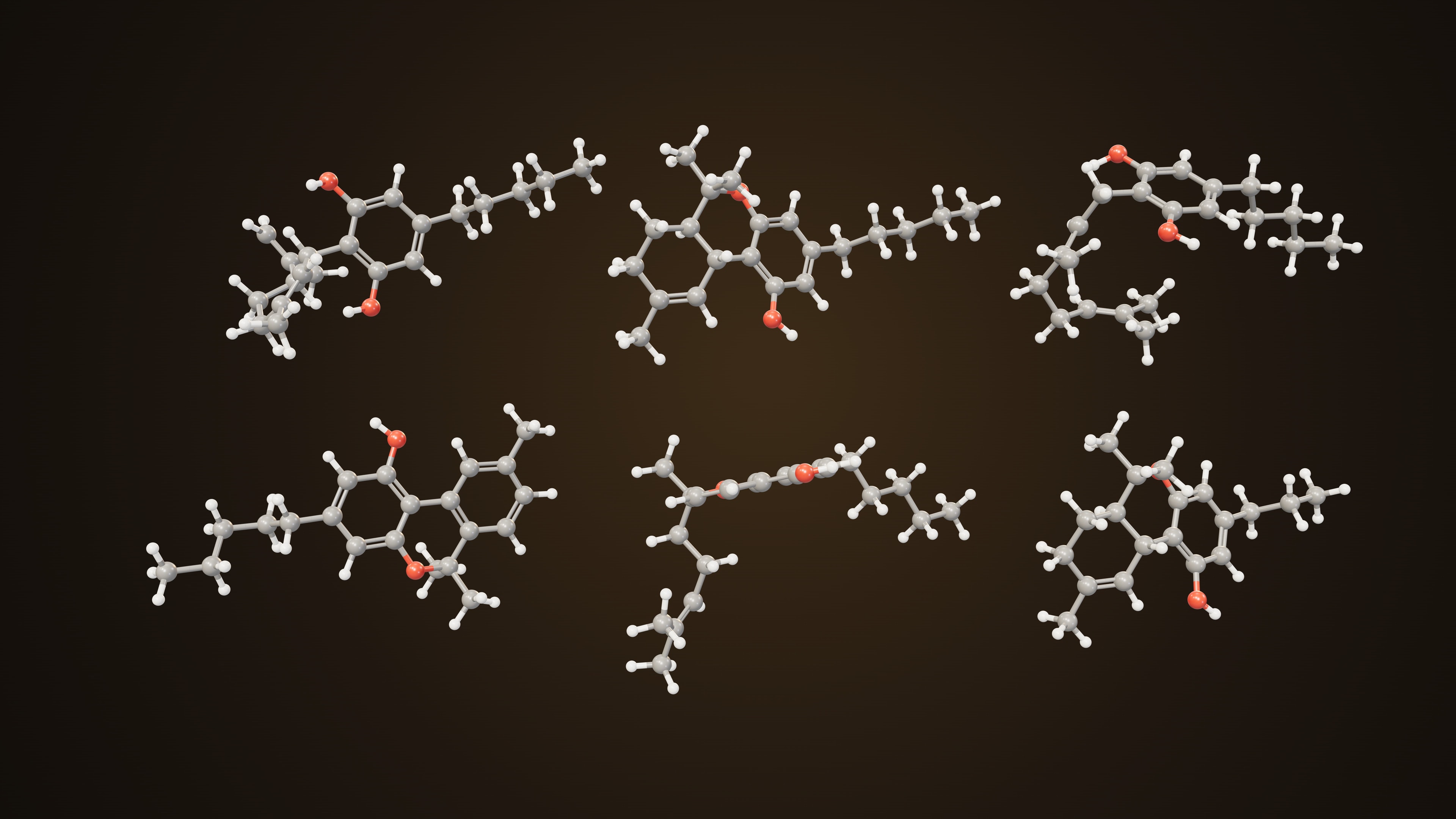
You may have heard the names CBD and THC, but cannabis contains far more than these two. Abbreviations such as CBG, CBN and THCV are showing up more and more often on product labels, and it can be confusing to know which is which. In this article, we explain in plain language what cannabinoids are, which groups of them are found in cannabis, and what research says today about the best-known ones.
What’s in this article?10 sections
What are cannabinoids?
Cannabinoids are a family of substances found in cannabis (Cannabis sativa) that have similar chemical structures. More than 500 substances have been reported in cannabis; 125 of them have been identified as cannabinoids. The rest are terpenes, which give the plant its smell, flavonoids and other compounds (Radwan 2021).
Cannabinoids are made in tiny secretory hairs (trichomes) on the plant’s surface. In the plant, most are first present in an "acid" form: for example, the form of THC in the plant is THCA, which turns into THC over time or with heat (Radwan 2021). That’s why certificates of analysis list THC and THCA, and CBD and CBDA, on separate lines. In the plant, the first cannabinoid on the pathway to THC is CBGA (cannabigerolic acid) (Radwan 2021). Some of this variety may also come from the main cannabinoids breaking down with heat, light and air (Hanuš 2016).
Our bodies’ own cannabinoids
The human body also makes cannabinoid-like substances, called endocannabinoids. The best known are anandamide and 2-AG. Together with the receptors they bind to (most commonly CB1, and also CB2) and the enzymes that make and break them down, these substances form the endocannabinoid system. The system plays a role especially in the development of the nervous system and in fine-tuning communication between nerve cells. Plant cannabinoids such as THC produce their effects through these receptors (Lu and Mackie 2016).
A substance interacting with this system does not, on its own, show that it works for a disease; only studies in people can show that. More: what is the endocannabinoid system?
Which cannabinoids are found in cannabis?
Scientists sort the 125 cannabinoids in cannabis into 11 groups based on their chemical structure (Radwan 2021). In the table below, you can see how many substances have been identified in each group so far and its best-known members.
Group | Number of substances identified | Known examples |
|---|---|---|
Δ9-THC (tetrahydrocannabinol) type | 25 | THC, THCA, THCV (tetrahydrocannabivarin) |
Δ8-THC type | 5 | Δ8-THC |
CBG (cannabigerol) type | 16 | CBG, CBGA |
CBD (cannabidiol) type | 10 | CBD, CBDA, CBDV (cannabidivarin) |
CBC (cannabichromene) type | 9 | CBC, CBCA |
CBN (cannabinol) type | 11 | CBN |
CBT (cannabitriol) type | 9 | CBT |
CBE (cannabielsoin) type | 5 | CBE |
CBL (cannabicyclol) type | 3 | CBL |
CBND (cannabinodiol) type | 2 | CBND |
Others | 30 | Cannabifuran (CBF), dehydrocannabifuran (DCBF), OTHC |
Most of these substances are found in the plant in very small amounts, and their effects in humans have never been studied. A cannabinoid being on the list does not mean it has any effect on health.
The best-known cannabinoids: what does the research say?
- THC: The main intoxicating substance in cannabis; it directly stimulates the CB1 and CB2 receptors in the brain (Pertwee 2008). Some medicines containing THC are approved in some countries for certain conditions. More: the differences between THC and CBD.
- CBD: Does not cause a high. The approved (licensed) CBD medicine reduced seizures in some severe childhood epilepsies (Devinsky 2017). Research on many other topics is ongoing: What is CBD?
- CBG: There are very few controlled studies in humans. In a study of 34 healthy adults run online from their homes, a single 20 mg dose of CBG lowered anxiety and stress scores compared with placebo (an inactive substance) (Cuttler 2024). How it acts in patients is not known.
- CBN: It forms when THC breaks down in air and is marketed in sleep products. In a 293-person study run by the manufacturing company, 20 mg of CBN reduced night-time awakenings but did not change how long it took to fall asleep (Bonn-Miller 2024). In 20 people diagnosed with insomnia, 30 or 300 mg of CBN given on a single night did not change the main outcome measured in the sleep lab (Lavender 2026). More: What is CBN?
- THCV: In a small pilot study of 62 people with type 2 diabetes, THCV lowered fasting blood sugar compared with placebo (Jadoon 2016). Because it is a single small study, it cannot serve as a basis for any treatment recommendation. More: What is THCV?
- Δ8-THC: It occurs naturally in cannabis only in very small amounts; Δ8-THC products on the market are mostly made chemically from CBD. Like THC, Δ8-THC causes a high, and the US Food and Drug Administration (FDA) warns that these products have not been evaluated for safe use (FDA).
What is the "entourage effect"?
The idea that the substances in cannabis work better together than they do on their own is called the entourage effect. The term was first used in 1998, not for the plant but for cell and mouse experiments with substances the body makes itself (Ben-Shabat 1998). It later became widespread in the marketing of "full-spectrum" products. Reviews stress that the evidence supporting this idea in humans is limited and that it should not be presented as a proven fact (Simei 2024; Cogan 2020). More: CBD spectrum guide.
Possible side effects and drug interactions
Every cannabinoid is different, and the safety of most of them in humans is not known. The most information is available for THC and CBD:
- THC causes a high and impairs attention and memory; addiction can develop in regular users. More: what is marijuana?
- CBD can cause drowsiness, diarrhea and decreased appetite; by slowing down how some medicines are broken down in the liver, it can interact with clobazam, valproate, warfarin and some organ transplant medicines (Epidiolex label). For the medicine you take: check CBD drug interactions.
- Doping tests: CBG and CBDV, which the World Anti-Doping Agency banned at the time, were detected in the urine of volunteers using a broad-spectrum CBD product (Gillham 2026).
- Synthetic cannabinoids are substances made in a lab; they should not be confused with the cannabinoids in cannabis. Under the Turkish Penal Code, they are listed among the substances that increase the penalty (TCK Art. 188/4).
If you are considering a product that contains cannabinoids
You can talk with your doctor or pharmacist about the medicines you take, your liver health, pregnancy or breastfeeding, and topics such as drug or doping tests. It also helps to check the product’s certificate of analysis to see which cannabinoids it contains and how much: how to read a label? Plain explanations of terms: CBD glossary.
In Turkey, cannabis-derived products, including CBD, can be sold only in pharmacies (Law No. 7557; regulation of January 31, 2026). Those classed as medicines and health products are dispensed with a prescription; for supplement products with a THC content of no more than 0.3%, no prescription requirement is stated. As of October 2026, there is no approved (licensed) CBD medicine in Turkey (TİTCK, the Turkish Medicines and Medical Devices Agency). More: CBD regulations in Turkey.
Conclusion
Cannabinoids are a surprisingly large family of substances unique to cannabis. THC and CBD are the two members we know the most about today; for others such as CBG, CBN and THCV, the first small human studies are only now coming in. When you see these names on a product label, it’s good to keep in mind that most of the research is still at an early stage.
This article is for information only; it is not a diagnosis or treatment recommendation. We don’t sell products or recommend products or brands. How we prepare our content: Editorial Policy. If you spot an error, write to [email protected] .
Frequently asked questions
What are cannabinoids?
Cannabinoids are a family of substances unique to cannabis that have similar chemical structures. The best known are THC and CBD. Similar substances made by our bodies are called endocannabinoids.
How many cannabinoids are there in cannabis?
More than 500 substances have been reported in cannabis; 125 of them have been identified as cannabinoids and are sorted into 11 groups. Most are found in the plant in very small amounts, and their effects in humans have not been studied.
Which cannabinoids cause a high?
The main intoxicating substance is THC; Δ8-THC also causes a high in a similar way. CBD does not cause a high. For most other cannabinoids, there is not enough information in humans.
Do CBG, CBN and THCV work?
There are a small number of small studies of these substances in humans, and the results are limited. For example, two studies of CBN on sleep gave different results, and for THCV there is only a single small diabetes study. For now, it is not possible to make any recommendation based on them.
Has the entourage effect been proven?
No. Although the idea that the substances in cannabis work better together is appealing, reviews say the evidence supporting it in humans is limited. The term was first used in 1998 for animal experiments with the body’s own substances.
Are products containing cannabinoids legal in Turkey?
Cannabis-derived products, including CBD, can be sold only in pharmacies (Law No. 7557, regulation of January 31, 2026). Those classed as medicines and health products are dispensed with a prescription; for supplement products with a THC content of no more than 0.3%, no prescription requirement is stated. As of October 2026, there is no approved (licensed) CBD medicine in Turkey.
References
Show 19 references
- Radwan MM, et al. Cannabinoids, Phenolics, Terpenes and Alkaloids of Cannabis. Molecules. 2021. PMID 34066753
- Hanuš LO, et al. Phytocannabinoids: a unified critical inventory. Nat Prod Rep. 2016. PMID 27722705
- Lu HC, Mackie K. An Introduction to the Endogenous Cannabinoid System. Biol Psychiatry. 2016. PMID 26698193
- Pertwee RG. The diverse CB1 and CB2 receptor pharmacology of three plant cannabinoids: delta9-tetrahydrocannabinol, cannabidiol and delta9-tetrahydrocannabivarin. Br J Pharmacol. 2008. PMID 17828291
- Devinsky O, et al. Trial of Cannabidiol for Drug-Resistant Seizures in the Dravet Syndrome. N Engl J Med. 2017. PMID 28538134
- Cuttler C, et al. Acute effects of cannabigerol on anxiety, stress, and mood: a double-blind, placebo-controlled, crossover, field trial. Sci Rep. 2024. PMID 39003387
- Bonn-Miller MO, et al. A double-blind, randomized, placebo-controlled study of the safety and effects of CBN with and without CBD on sleep quality. Exp Clin Psychopharmacol. 2024. PMID 37796540
- Lavender IG, et al. Cannabinol for Acute Treatment of Insomnia Disorder in a Randomized Placebo-Controlled Crossover Trial. J Sleep Res. 2026. PMID 41698831
- Jadoon KA, et al. Efficacy and Safety of Cannabidiol and Tetrahydrocannabivarin on Glycemic and Lipid Parameters in Patients With Type 2 Diabetes: A Randomized, Double-Blind, Placebo-Controlled, Parallel Group Pilot Study. Diabetes Care. 2016. PMID 27573936
- US FDA. 5 Things to Know about Delta-8 Tetrahydrocannabinol – Delta-8 THC (content dated May 4, 2022; accessed October 20, 2026).
- Ben-Shabat S, et al. An entourage effect: inactive endogenous fatty acid glycerol esters enhance 2-arachidonoyl-glycerol cannabinoid activity. Eur J Pharmacol. 1998. PMID 9721036
- Simei JLQ, et al. Does the "Entourage Effect" in Cannabinoids Exist? A Narrative Scoping Review. Cannabis Cannabinoid Res. 2024. PMID 37535820
- Cogan PS. The 'entourage effect' or 'hodge-podge hashish': the questionable rebranding, marketing, and expectations of cannabis polypharmacy. Expert Rev Clin Pharmacol. 2020. PMID 32116073
- US FDA / DailyMed. EPIDIOLEX (cannabidiol) prescribing information, revision 05/2026.
- Gillham SH, et al. Daily Use of a Broad-Spectrum Cannabidiol Supplement Produces Detectable Concentrations of Cannabinoids in Urine Prohibited by the World Anti-Doping Agency: An Effect Amplified by Exercise. Med Sci Sports Exerc. 2026. PMID 40920736
- Law No. 5237, Türk Ceza Kanunu (Turkish Penal Code), Art. 188 (current text, mevzuat.gov.tr; accessed October 20, 2026).
- Law No. 7557. Official Gazette 32965, July 24, 2025.
- Ministry of Health of the Republic of Turkey. Kenevirden Elde Edilen Ürünlere Dair Yönetmelik (Regulation on Products Derived from Hemp). Official Gazette 33154, January 31, 2026.
- TİTCK (Turkish Medicines and Medical Devices Agency). List of Licensed Human Medicinal Products (October 16, 2026).
 Is CBD Considered a Drug? How CBD Oil Differs from Hemp Seed Oil
 CBD and Inflammation: What Does the Research Say?
 What Is Cannabinoid Signaling?
 Hemp and Marijuana: What’s the Difference?