
Science: cannabinoids and the body
Your Body's Hidden Balancing System: The Endocannabinoid System (ECS) and CBD's Role
Our bodies make their own signaling molecules that resemble compounds in cannabis. We explain in plain language how the endocannabinoid system was discovered, how it works and how CBD interacts with it.
By: Selçuk GündoğduUpdated: 23 sources
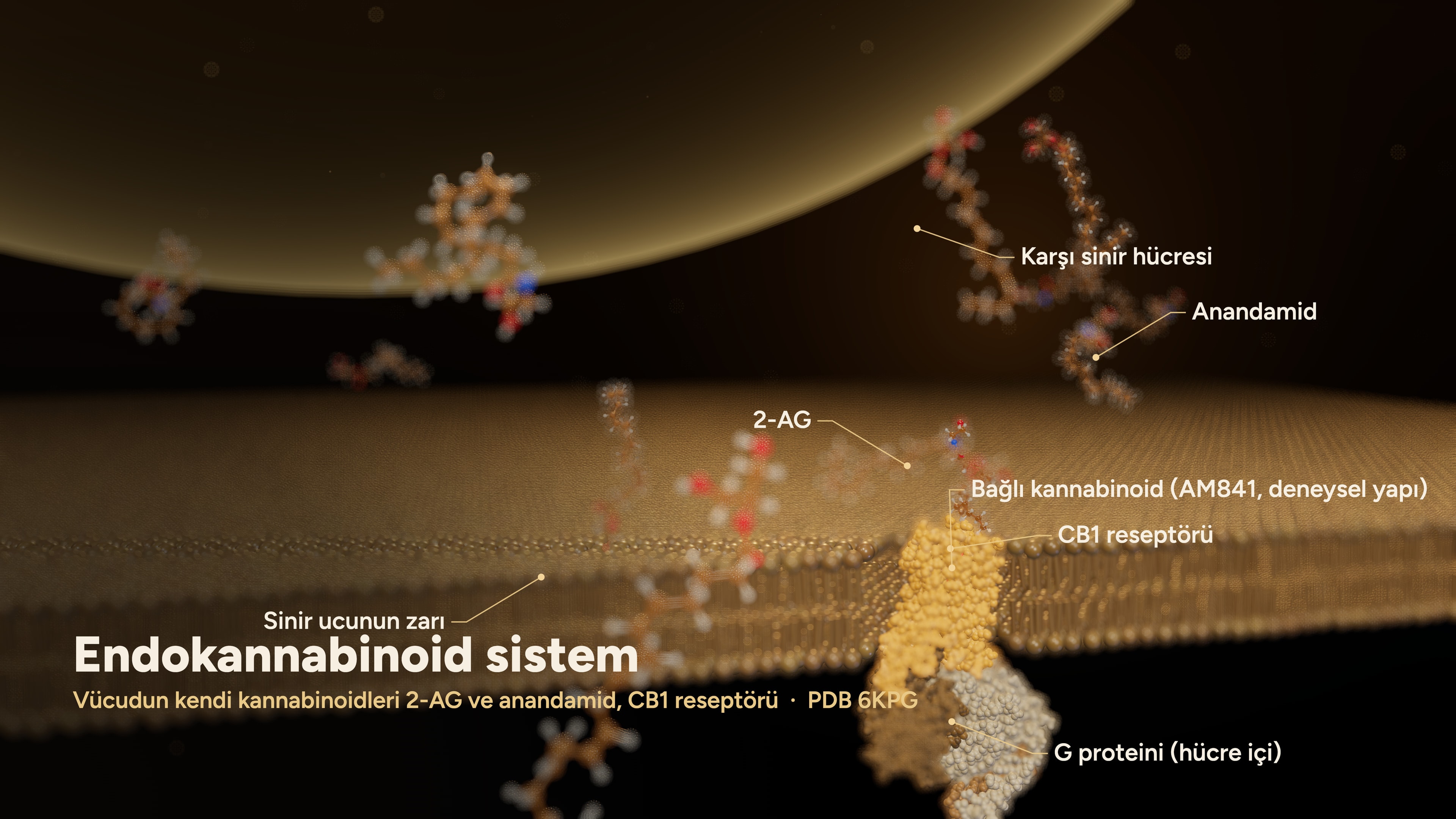
Almost every article you read about CBD mentions the "endocannabinoid system." It may sound complicated, but the basic idea is quite simple: our bodies make their own signaling molecules that resemble compounds in cannabis. In this article we explain in plain language how this system was discovered, how it works, how CBD interacts with it, and what this information does and does not mean for health. Short explanations of the terms are on our glossary page.
What’s in this article?12 sections
What is the endocannabinoid system?
The story began with THC. While searching for what THC, the compound behind marijuana's effects, binds to in the brain, researchers identified a receptor called CB1 in 1990 (Matsuda 1990). It then became clear that the body makes its own molecules that bind to this receptor: anandamide was found in 1992 (Devane 1992) and 2-AG in 1995 (Mechoulam 1995). In 1993, a second receptor, CB2, was identified, found not in the brain but in immune cells (Munro 1993). That is where the system's name comes from: "endo" means from within, that is, the body's own cannabinoids.
Today the ECS is described as a widespread regulatory network involved in brain development and in many cognitive and bodily processes (Lu and Mackie 2021).
Parts of the system
Part | Examples | What does it do? |
|---|---|---|
Endocannabinoids | Anandamide, 2-AG | Fat-based signaling molecules made by the body; they are released quickly when needed. |
Receptors | CB1, CB2 | CB1 is widespread in the brain and is THC's main target; CB2 is found mainly on immune cells. |
Enzymes | FAAH, MAGL | Break down signaling molecules once their job is done: FAAH mainly anandamide, MAGL mainly 2-AG. |
How does it work?
Nerve cells in the brain "talk" to each other with chemical messages: one cell sends the message, the other receives it. The interesting thing about the endocannabinoid system is that the receiving cell can, when needed, turn back and tell the sending cell to "slow down a bit." Stimulated nerve cells quickly release anandamide and 2-AG; these molecules travel backward, bind to CB1 receptors on the cell sending the message, and reduce the amount of messenger it releases for a while (Wilson and Nicoll 2001). This backward signaling is the main way the system regulates short- and long-term changes at synapses; in some cases it has been shown to signal in other ways too (Castillo 2012). That is why the ECS is often compared to the brain's "fine-tuning" or "brake" system.
You can also take a look at our article on cannabinoid signaling, where we explain how this signaling works in more detail.
The "endocannabinoid deficiency" idea
Some researchers suggest that this system does not work well enough in pain conditions whose causes are not fully understood, such as migraine, fibromyalgia and irritable bowel syndrome. A review advocating this idea, called "clinical endocannabinoid deficiency," reports that anandamide levels in spinal fluid were found to be different in people with migraine (Russo 2016). But this is a hypothesis; it does not show that CBD works in these diseases. Indeed, in a 24-week study of 200 patients with fibromyalgia, 50 mg of CBD a day reduced pain less than placebo (Rasmussen 2026).
How does CBD interact with this system?
CBD (cannabidiol) is also a cannabinoid found in cannabis, but it approaches this system very differently from THC:
- It does not directly activate CB1: THC binds to CB1 and activates it, which is why it causes a high. In lab cell studies, CBD instead bound to a different site on CB1 and acted like a "modulator" that reduces the receptor's response to THC and 2-AG (Laprairie 2015).
- It may slow the breakdown of anandamide: CBD moderately inhibits the enzyme that breaks down anandamide. In a study of patients with schizophrenia, blood anandamide levels rose in those taking CBD (Leweke 2012).
- It has other targets too: In animal studies, targets outside the ECS, such as serotonin receptors, also appear to contribute to CBD's effects (Jantsch 2026).
These effects seen in the lab do not always produce the expected result in humans. For example, marijuana containing both THC and CBD caused less anxiety than marijuana containing only THC; but in people with high anxiety at the start, CBD did not prevent the anxiety caused by THC (Hutten 2022). In another study, CBD given beforehand did not reduce THC's negative effect on attention and thinking speed (Woelfl 2020).
What does this information mean for health?
A substance interacting with this system does not, on its own, show that it works for a disease. Only controlled studies, in which patients are randomly assigned to groups taking CBD or an inactive drug (placebo), can show that. Roughly, today's picture looks like this:
Area | Strength of evidence (pure CBD) | In short |
|---|---|---|
The approved CBD medicine reduced seizures in Dravet and Lennox–Gastaut syndromes (strong) and in tuberous sclerosis (moderate) (Devinsky 2017; Thiele 2021). | ||
Some positive signals with a single dose; in pooled analysis the evidence is of low quality and the effect is limited (Raminelli 2025). | ||
In 15 of 16 controlled studies with pure CBD, it was not superior to placebo (Moore 2024). | ||
CBD-only products did not significantly improve sleep quality compared with placebo (da Silva 2025). |
The evidence for other topics is summarized one by one in the CBD Guide.
Possible side effects and drug interactions
- Liver: In a controlled study in healthy adults, liver enzymes rose to more than 3 times the normal level in 5.6% of those taking CBD for 28 days; this was not seen in the placebo group (Florian 2025).
- Drug interactions: CBD can slow how the body breaks down some medicines. In healthy adults, the total blood level of citalopram rose by 43% (Salcedo 2026); in children with epilepsy, clobazam and its byproduct rose markedly (Geffrey 2015).
- Common side effects: In epilepsy studies, the most commonly reported side effects were sleepiness, fatigue, diarrhea and vomiting (Devinsky 2017).
Details are on the drug interactions and safety pages.
How was it used in the studies?
The following are only doses used in research (study doses; not a personal recommendation). In the liver safety study, healthy adults took 5 mg of CBD per kilogram of body weight per day, split into two doses, for 28 days; the researchers say they chose this dose within the range taken by people who use over-the-counter products (Florian 2025). In the epilepsy studies, 10–20 mg of the approved CBD medicine per kilogram per day was used (Devinsky 2017).
If you are considering CBD
After learning about the ECS, it is understandable that you might consider trying CBD. You can talk about the following with your doctor or pharmacist:
- Which complaint you are considering CBD for, and where the evidence stands on it.
- The medicines you take and possible interactions.
- Liver disease, pregnancy or breastfeeding.
- How to read a product label (label reading guide).
In Turkey, cannabis-derived products, including CBD, can be sold only in pharmacies (Law No. 7557, regulation of January 31, 2026). Those classed as medicines or health products are dispensed on prescription; no prescription requirement is stated for supplement products with at most 0.3% THC. As of October 2026, there is no approved CBD medicine in Turkey. Details are on our regulations page.
Conclusion
The endocannabinoid system is an important regulatory network that works with the body's own cannabinoids and fine-tunes communication between nerve cells. CBD interacts with this system in ways that differ from THC; but this interaction does not mean CBD works for a disease. Today, the area where this has been strongly shown is drug-resistant epilepsy syndromes treated with the approved CBD medicine.
Frequently asked questions
What is the endocannabinoid system?
It is a regulatory network made up of signaling molecules the body makes itself, such as anandamide and 2-AG, the CB1 and CB2 receptors they bind to, and the enzymes that break them down. In the brain it fine-tunes communication between nerve cells, and it plays a role in many cognitive and bodily processes.
How does CBD affect the endocannabinoid system?
Unlike THC, CBD does not directly activate the CB1 receptor. In lab studies, it acted like a modulator that reduces the receptor's response to THC, and it moderately slowed the breakdown of anandamide. What these effects lead to in humans is not always clear.
Is there a disease called endocannabinoid deficiency?
"Clinical endocannabinoid deficiency" is a hypothesis proposed to explain conditions such as migraine and fibromyalgia; it is not a diagnosed disease. This hypothesis also does not show that CBD works in these diseases; in a large study in fibromyalgia, CBD was not found to be better than placebo.
Since CBD "balances" the system, is it good for every disease?
No. A substance interacting with this system does not, on its own, show that it works for a disease. Today, the area where CBD's effect has been strongly shown is certain drug-resistant epilepsy syndromes treated with the approved CBD medicine; in anxiety, sleep and pain, the evidence is weak or negative.
Where can CBD products be bought in Turkey?
In Turkey, cannabis-derived products, including CBD, can be sold only in pharmacies (Law No. 7557, regulation of January 31, 2026). Those classed as medicines or health products are dispensed on prescription; no prescription requirement is stated for supplement products with at most 0.3% THC. As of October 2026, there is no approved CBD medicine in Turkey.
References
Show 23 references
- Matsuda LA, et al. Structure of a cannabinoid receptor and functional expression of the cloned cDNA. Nature. 1990. PMID 2165569
- Devane WA, et al. Isolation and structure of a brain constituent that binds to the cannabinoid receptor. Science. 1992. PMID 1470919
- Mechoulam R, et al. Identification of an endogenous 2-monoglyceride, present in canine gut, that binds to cannabinoid receptors. Biochem Pharmacol. 1995. PMID 7605349
- Munro S, et al. Molecular characterization of a peripheral receptor for cannabinoids. Nature. 1993. PMID 7689702
- Lu HC, Mackie K. Review of the Endocannabinoid System. Biol Psychiatry Cogn Neurosci Neuroimaging. 2021. PMID 32980261
- Wilson RI, Nicoll RA. Endogenous cannabinoids mediate retrograde signalling at hippocampal synapses. Nature. 2001. PMID 11279497
- Castillo PE, et al. Endocannabinoid signaling and synaptic function. Neuron. 2012. PMID 23040807
- Russo EB. Clinical Endocannabinoid Deficiency Reconsidered: Current Research Supports the Theory in Migraine, Fibromyalgia, Irritable Bowel, and Other Treatment-Resistant Syndromes. Cannabis Cannabinoid Res. 2016. PMID 28861491
- Rasmussen MU, et al. Cannabidiol versus placebo in patients with fibromyalgia: a randomised, double-blind, placebo-controlled, parallel-group, single-centre trial. Ann Rheum Dis. 2026. PMID 40846590
- Laprairie RB, et al. Cannabidiol is a negative allosteric modulator of the cannabinoid CB1 receptor. Br J Pharmacol. 2015. PMID 26218440
- Leweke FM, et al. Cannabidiol enhances anandamide signaling and alleviates psychotic symptoms of schizophrenia. Transl Psychiatry. 2012. PMID 22832859
- Jantsch J, et al. Effects of cannabidiol on anxiety- and depressive-like behaviors and cognition: a systematic review and meta-analysis of preclinical studies. Mol Psychiatry. 2026. PMID 42380607
- Hutten NRPW, et al. Cannabis containing equivalent concentrations of delta-9-tetrahydrocannabinol (THC) and cannabidiol (CBD) induces less state anxiety than THC-dominant cannabis. Psychopharmacology (Berl). 2022. PMID 36227352
- Woelfl T, et al. Effects of Cannabidiol and Delta-9-Tetrahydrocannabinol on Emotion, Cognition, and Attention: A Double-Blind, Placebo-Controlled, Randomized Experimental Trial in Healthy Volunteers. Front Psychiatry. 2020. PMID 33304282
- Devinsky O, et al. Trial of Cannabidiol for Drug-Resistant Seizures in the Dravet Syndrome. N Engl J Med. 2017. PMID 28538134
- Thiele EA, et al. Add-on Cannabidiol Treatment for Drug-Resistant Seizures in Tuberous Sclerosis Complex: A Placebo-Controlled Randomized Clinical Trial. JAMA Neurol. 2021. PMID 33346789
- Raminelli AO, et al. Effects of Different Cannabinoid Formulations on Anxiety-Related Disorders, and Tourette Syndrome: A Systematic Review and Meta-Analysis. Cannabis Cannabinoid Res. 2025. PMID 40956670
- Moore A, et al. Cannabidiol (CBD) Products for Pain: Ineffective, Expensive, and With Potential Harms. J Pain. 2024. PMID 37863344
- da Silva GHS, et al. Effectiveness of cannabinoids on subjective sleep quality in people with and without insomnia or poor sleep: A systematic review and meta-analysis of randomised studies. Sleep Med Rev. 2025. PMID 40929927
- Florian J, et al. Cannabidiol and Liver Enzyme Level Elevations in Healthy Adults: A Randomized Clinical Trial. JAMA Intern Med. 2025. PMID 40622698
- Salcedo P, et al. Clinical Study to Evaluate Drug Interactions of Cannabidiol with Citalopram and Morphine in Healthy Adults. Clin Pharmacol Ther. 2026. PMID 41622700
- Geffrey AL, et al. Drug-drug interaction between clobazam and cannabidiol in children with refractory epilepsy. Epilepsia. 2015. PMID 26114620
- Ministry of Health. Kenevirden Elde Edilen Ürünlere Dair Yönetmelik (Regulation on Products Derived from Hemp). Official Gazette, January 31, 2026, issue 33154. Official Gazette 33154
 What Is THC? Differences Between THC and CBD, Their Effects and Legal Status
 What Is THCV (Tetrahydrocannabivarin)? The Molecule, the Research and Its Legal Status
 What Is Cannabinol (CBN)? Sleep Claims and Research
 NewWhat Is HHC (Hexahydrocannabinol)? Effects, Risks and Legal Status