
Science: cannabinoids and the body
What Are Synthetic Cannabinoids? What’s in the Liquids, Puffs and Gummies Sold as "THC"?
What has been found in products sold as "THC liquid," "THC puff" or "THC gummies"? We explain, with sources, what synthetic cannabinoids are, their risks, data from Turkey and their legal status.
By: Selçuk GündoğduUpdated: 32 sources
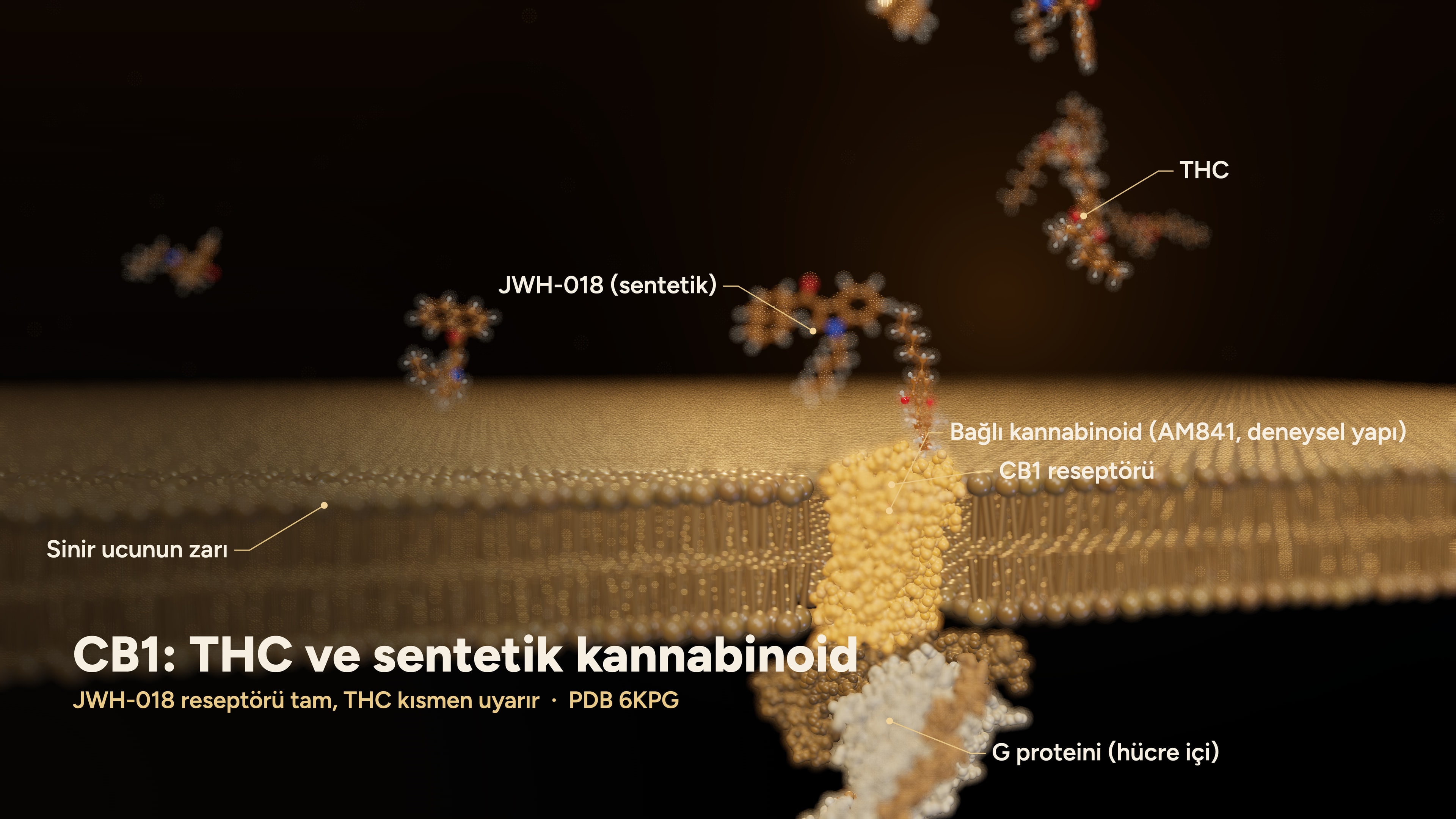
Many people who search online for "THC liquid," "THC puff" or "THC gummies" are really wondering: What’s inside these products? To answer that, you first need to know about synthetic cannabinoids, because analyses in Europe have found these compounds in a significant share of products sold as "THC." In this article, we explain in plain language what synthetic cannabinoids are, how they differ from THC, their known risks, data from Turkey and their legal status. We don’t give any product, brand or usage information.
What’s in this article?10 sections
At a glance
Synthetic cannabinoids | |
|---|---|
Where do they come from? | Made entirely in a lab; no chemical link to cannabis |
Effect | Often activate the brain’s cannabinoid receptors far more strongly than THC |
Drug testing | Standard cannabis tests often don’t detect them |
Turkey | Covered by Law No. 2313; controlled since 2015 under a generic definition based on chemical structure; under TCK 188/4, the penalty for manufacturing and trafficking is increased by half |
UN and EU | Many are listed individually under the 1971 UN Convention; in the EU, they are controlled through early warning and risk assessment |
What is a synthetic cannabinoid?
Synthetic cannabinoids are compounds made in a lab that bind to cannabinoid receptors in the brain. Although they are called "cannabinoids," they are not obtained from the cannabis plant; many of them don’t even resemble THC chemically (EUDA 2015). In Europe, they were first noticed at the end of 2008 in products sold as "herbal blends" that contained no cannabis; the compound had been sprayed onto dried plant material (EUDA 2015).
In Turkey, synthetic cannabinoids were first detected in 2010, and they are best known as "bonzai" (TUBİM 2026). "Jamaika" is another commonly used name (Aladağ-Çiftdemir 2016).
These compounds should not be confused with semi-synthetic cannabinoids such as HHC and Δ8-THC. Semi-synthetics are made chemically from a compound obtained from cannabis (usually CBD), and their structure is similar to THC; synthetic cannabinoids, by contrast, are made in a lab from start to finish.
New ones keep appearing. The number of new cannabinoids monitored by EUDA, Europe’s drug monitoring agency, reached 304 by the end of 2025; 40 of these are semi-synthetic, and the vast majority are synthetic. In 2025 alone, 27 new cannabinoids were reported (EUDA 2026). In Turkey, 58,316 incidents involving synthetic cannabinoids were recorded in 2025; 2,956 kg of product and 489 kg of raw material were seized (TUBİM 2026).
How they differ from THC: why are they more unpredictable?
THC partially activates the CB1 receptor in the brain. Most synthetic cannabinoids, however, activate this receptor fully and very strongly (Alves 2020; Craft 2025). In lab and animal studies, they were found to be 2 to 100 times more potent than THC (Castaneto 2014).
Another problem is inconsistent amounts. Because the raw material is spread unevenly over the plant material, differences of up to 20% were measured between samples from the same package and up to 33% between different packages (Moosmann 2015). Across 69 packages, the highest concentration was 2.7 times the lowest (Frinculescu 2017). According to the Turkish Drug Report, in Turkey the raw material is mostly sold soaked into plant materials such as sage, thyme, tobacco and henna; in some cases, toxic additives such as insecticides and pesticides were also found (TUBİM 2026).
Strength of evidence: lab studies and product analyses; consistent results.
Known risks
- Symptoms: In a systematic review bringing together 106 studies and about 4,000 cases, the most common effects were a racing heart (37–77%), agitation (16–41%) and nausea (13–94%). Severe effects included stroke, seizures, heart attack, muscle breakdown, acute kidney injury, psychosis and recurring bouts of vomiting; at least 26 deaths were reported (Tait 2016).
- Emergency visits: In an international survey of 22,289 people, the risk of needing emergency treatment was about 30 times higher for people using synthetic cannabinoids than for people using cannabis (Winstock 2015).
- Mass poisonings: In the US in 2016, 33 people were poisoned by a single product on the same day (Adams 2017). In 2018, synthetic cannabinoid products contaminated with rat poison caused severe bleeding in more than 150 people (Kelkar 2018).
- Deaths in Europe: According to the EU control decision, one synthetic cannabinoid was linked to 12 deaths in two EU countries, and another to 21 deaths in a single country within four months (EU 2021/802).
- Deaths in Turkey: According to data from the Council of Forensic Medicine, 557 directly drug-related deaths were recorded in 2025; synthetic cannabinoids were found in 63% (351) of them, and in 222 the death was caused by this substance alone. Deaths in which synthetic cannabinoids were found numbered 8 in 2022, 61 in 2023 and 204 in 2024 (TUBİM 2026).
- Dependence: People who use synthetic cannabinoids report severe side effects, withdrawal symptoms and dependence (Cozier 2025).
- Tests: Standard cannabis tests don’t detect most synthetic cannabinoids; because the compounds change quickly and break down rapidly in the body, they are hard to detect even in a lab (Castaneto 2014; Baginski 2025). So a negative test does not mean a person hasn’t used anything.
Strength of evidence: a systematic review, official death data and outbreak investigations; consistent on serious harm.
What has been found in products sold as "THC liquid," "THC puff" and "THC gummies"?
We could not find a published study examining the contents of these products in Turkey. However, the Turkish Drug Report states that, in addition to herbal blends, synthetic cannabinoids are also put on the market as "products soaked into paper, liquid forms and e-cigarette cartridges" (TUBİM 2026). Analyses in Europe show that a "THC" label is no guarantee of the contents:
Liquids and vapes (vape, puff)
- In England, of 512 e-cigarette and liquid samples confiscated by teachers at 27 schools, 17.4% contained synthetic cannabinoids and only 1.2% contained THC; 77.8% of the schools had at least one sample with a synthetic cannabinoid. Most of these were refillable devices and liquid bottles; they were less common in disposable devices (Cozier 2025).
- Of 312 samples sent to Wales’s national drug analysis service between April 2025 and March 2026 as "THC," "CBD" or cannabis liquid, 134 (43%) contained synthetic cannabinoids (WEDINOS 2026).
- In all 7 disposable vapes sold as cannabis products, a synthetic cannabinoid was found instead of THC. The devices looked very much like legal products; there was nothing on the packaging indicating the contents (Craft 2025).
- In Europe, of 1,142 samples sold as cannabis and brought as suspicious to 9 drug checking services in 8 countries, 270 contained the same synthetic cannabinoid; the liquids contained no natural cannabinoids at all (Oomen 2022).
- In England, among 7 patients who went to the hospital after using a vape and whose synthetic cannabinoid exposure was confirmed in the lab, the median age was 17; 6 had extreme agitation and 4 had psychotic symptoms (Pucci 2025).
Gummies and edibles
- Of 31 products seized by UK police in 2024, one contained a synthetic cannabinoid instead of THC. The packaging of 79% of the products imitated well-known candy brands; of 68 pieces labeled with a THC amount, 65 contained less than 55% of the stated amount (Gardner 2026).
- In Ireland, only 64% of 114 gummy, candy and chocolate products tested in 2023 contained THC; synthetic cannabinoids and HHC were found in the rest. After young people were hospitalized, a public health warning was issued in January 2023 (HRB 2026).
- EUDA warns that synthetic cannabinoids can be mixed into, or sold in place of, cannabis and semi-synthetic products, including cannabis edibles (EUDA 2025). In 2024, about 37% of the synthetic and semi-synthetic cannabinoid material seized in Europe was edibles and vapes (EUDA 2026).
"CBD" and low-THC cannabis
- In Switzerland, half of 94 cannabis samples brought to drug checking services in 2020–2021 contained synthetic cannabinoids. All of these flowers were low-THC products with no more than 1% THC, that is, legally sold products; people who used them more often had adverse effects, especially psychological and heart-related effects (Monti 2022).
- In Italy, 4 of 26 "legal" cannabis products bought online contained synthetic cannabinoids, and 92.3% were mislabeled (Giorgetti 2026).
- EUDA says it is concerned about the growing adulteration of low-THC cannabis and CBD products with synthetic cannabinoids (EUDA 2026). We describe poisonings in the US linked to vape liquids sold as "CBD oil" on our Is CBD vaping harmful? page.
What do these findings mean?
These samples were not chosen at random: they were products confiscated at schools, seized by police or brought in for analysis by users who were suspicious. So the percentages don’t represent the whole market. But they clearly show that the problem is real and widespread: there is no way for a user to know what is inside a "THC" product bought from an unregulated source; synthetic cannabinoids can’t be told apart by look, smell or taste. In Turkey, hemp-derived products may be sold only in pharmacies and with a license; products sold online or on social media are outside this channel (legislation).
Strength of evidence: product analyses and case series; selected samples.
Legal status in Turkey
- How are they controlled? Under Article 19 of Law No. 2313, which substances are subject to this law is determined by Presidential decision (Law No. 2313, Art. 19). Synthetic cannabinoids were brought under control in 2011 (TUBİM 2026). A Council of Ministers Decision published in 2015 defined classes based on chemical structure instead of listing substances one by one; this way, new derivatives fall under its scope as soon as they appear (Council of Ministers Decision 2015/7238). This definition was expanded in 2016 (Council of Ministers Decision 2016/8548). Of the 1,090 substances brought under the law between 2008 and 2025, 461 are controlled through these generic definitions (TUBİM 2026).
- Penalties: Under paragraph 4 of Article 188 of the Turkish Penal Code, if the narcotic is a "synthetic cannabinoid or its derivatives," the penalty for manufacturing and trafficking is increased by half. This provision was added in 2015 (Law No. 6638) and expanded in 2023 to cover other substances as well (Law No. 7445). Buying, possessing and using for personal use are covered by Article 191 of the Turkish Penal Code (TCK).
The situation in Europe and worldwide
- UN: Many synthetic cannabinoids have been added individually to Schedule II of the 1971 UN Convention on Psychotropic Substances; for example, one of the most common in Europe was added in 2021 (UNODC 2021). In March 2026, the UN Commission on Narcotic Drugs added another synthetic cannabinoid to the list; this decision will take effect on November 25, 2026 (INCB 2026).
- European Union: New substances are monitored through the EU Early Warning System; substances found to be risky are brought under control across the EU after a risk assessment (Regulation (EU) 2017/2101; Directive (EU) 2017/2103). For example, in 2021, two synthetic cannabinoids were banned throughout the EU this way (EU 2021/802).
- China’s 2021 decision: In July 2021, China banned synthetic cannabinoids by structural class. This decision reduced the supply of the most common compounds in Europe at the time; however, production partly shifted to Europe (EUDA 2025; EUDA 2026).
When should you get help?
If, after using a liquid, vape, gummy or herbal blend of unknown content, someone has chest pain, a very fast heartbeat, a seizure, loss of consciousness or confusion, extreme agitation, sees or hears things that aren’t there, or has vomiting that won’t stop, go to a health care facility. If a child or teenager has used such a product, don’t wait for the symptoms to get worse. Because standard tests often don’t detect synthetic cannabinoids, it is important to tell the doctor what the product was sold as and to bring its packaging with you.
Frequently asked questions
Are bonzai and marijuana the same thing?
No. Marijuana comes from the cannabis plant, and its main active compound is THC. In products sold as bonzai, by contrast, lab-made synthetic cannabinoids have been soaked into plant material (TUBİM 2026). These compounds can act much more strongly on the same receptors in the brain (Castaneto 2014).
What are "THC liquid" and "THC puff," and do they really contain THC?
These names are used for e-cigarette liquids and disposable vapes said to contain THC. Among samples confiscated at schools in England, only 1.2% contained THC, while 17.4% contained synthetic cannabinoids (Cozier 2025). In Wales, 43% of samples sent for analysis as "THC," "CBD" or cannabis liquid contained synthetic cannabinoids (WEDINOS 2026). There is no way to know the contents by looking at what the label says.
Why are THC gummies risky?
Both the contents and the amount are uncertain. In one gummy product seized in the UK, a synthetic cannabinoid turned up instead of THC, and most pieces labeled with a THC amount contained much less THC than stated (Gardner 2026). In Ireland, more than a third of such products tested contained no THC (HRB 2026). Because the packaging looks like candy, there is also a risk of children eating them by accident.
Do synthetic cannabinoids show up on a drug test?
Standard cannabis tests often don’t detect them; special lab tests are needed, and even those can’t always catch new compounds that keep changing (Castaneto 2014; Baginski 2025).
Do synthetic cannabinoids have anything to do with CBD?
Not chemically. But in Europe, synthetic cannabinoids have been found added to some flowers and liquids sold as "CBD" or low-THC cannabis (Monti 2022; EUDA 2026). For information on CBD itself: What is CBD?
Are synthetic cannabinoids legal in Turkey?
No. They are covered by Law No. 2313, and since 2015 they have been controlled as classes defined by their chemical structure. The Turkish Penal Code provides for the penalty for manufacturing and trafficking these substances to be increased by half (TCK Art. 188/4).
References
Show 32 references
- EUDA 2015: Synthetic cannabinoids drug profile (January 8, 2015)
- EUDA 2025: European Drug Report 2025, New psychoactive substances (June 5, 2025)
- EUDA 2026: European Drug Report 2026, New psychoactive substances (June 9, 2026)
- TUBİM 2026: General Directorate of Security (EGM), Department of Anti-Narcotics, Turkish Drug Report 2026 (2025 data), pp. 111–113 and 186–188
- Aladağ-Çiftdemir N et al. A new emerging problem in pediatric emergency units: Synthetic cannabinoids. Turk J Pediatr. 2016;58(5):492-497. PMID 28621089
- Alves VL et al. The synthetic cannabinoids phenomenon: from structure to toxicological properties. A review. Crit Rev Toxicol. 2020;50(5):359-382. PMID 32530350
- Craft S et al. Detection and quantification of synthetic cannabinoids in seven illicitly sourced disposable vapes submitted by an individual presenting to a UK drug and alcohol service. Addiction. 2025;120(3):549-554. PMID 39256058
- Castaneto MS et al. Synthetic cannabinoids: epidemiology, pharmacodynamics, and clinical implications. Drug Alcohol Depend. 2014;144:12-41. PMID 25220897
- Moosmann 2015, Forensic Toxicology 33:54–60, doi:10.1007/s11419-014-0247-4
- Frinculescu A et al. Variation in commercial smoking mixtures containing third-generation synthetic cannabinoids. Drug Test Anal. 2017;9(2):327-333. PMID 27161591
- Tait RJ et al. A systematic review of adverse events arising from the use of synthetic cannabinoids and their associated treatment. Clin Toxicol (Phila). 2016;54(1):1-13. PMID 26567470
- Winstock A et al. Risk of emergency medical treatment following consumption of cannabis or synthetic cannabinoids in a large global sample. J Psychopharmacol. 2015;29(6):698-703. PMID 25759401
- Adams AJ et al. "Zombie" Outbreak Caused by the Synthetic Cannabinoid AMB-FUBINACA in New York. N Engl J Med. 2017;376(3):235-242. PMID 27973993
- Kelkar AH et al. An Outbreak of Synthetic Cannabinoid-Associated Coagulopathy in Illinois. N Engl J Med. 2018;379(13):1216-1223. PMID 30280655
- Cozier GE et al. Synthetic cannabinoids in e-cigarettes seized from English schools. Addiction. 2025;120(10):1995-2004. PMID 40574414
- Baginski SR et al. Structure-metabolism relationships of 4-pentenyl synthetic cannabinoid receptor agonists using in vitro human hepatocyte incubations and high-resolution mass spectrometry. Arch Toxicol. 2025;99(8):3331-3341. PMID 40392262
- WEDINOS 2026: WEDINOS Annual Report 2025–2026, v1.0 (August 25, 2026)
- Oomen PE et al. Cannabis adulterated with the synthetic cannabinoid receptor agonist MDMB-4en-PINACA and the role of European drug checking services. Int J Drug Policy. 2022;100:103493. PMID 34687992
- Pucci M et al. Seven patients with analytically confirmed MDMB-4en-PINACA toxicity associated with the use of electronic vaping devices. Clin Toxicol (Phila). 2025;63(5):360-362. PMID 40372197
- Gardner M et al. Identification and quantification of Δ-9-tetrahydrocannabinol and the synthetic cannabinoid MDMB-4en-PINACA in edible products seized by United Kingdom police in 2024. Addiction. 2026. PMID 42866963
- HRB 2026: Health Research Board, Drugnet Ireland 93 supplement (February 2026)
- Monti MC et al. Adulteration of low-delta-9-tetrahydrocannabinol products with synthetic cannabinoids: Results from drug checking services. Drug Test Anal. 2022;14(6):1026-1039. PMID 34997693
- Giorgetti A et al. Forensic profiling of synthetic and semi-synthetic cannabinoids in legal cannabis products in Italy. Forensic Sci Int. 2026;388:113114. PMID 42641241
- EU 2021/802: Commission Delegated Directive (EU) 2021/802 (March 12, 2021)
- Regulation (EU) 2017/2101 and Directive (EU) 2017/2103
- UNODC 2021: Placement of MDMB-4en-PINACA in Schedule II of the 1971 Convention
- INCB 2026: New substances under international control 2026
- Law No. 2313, Art. 19 (current text)
- Council of Ministers Decision (BKK) 2015/7238, Official Gazette 29259 (February 6, 2015)
- Council of Ministers Decision (BKK) 2016/8548, Official Gazette 29647 (March 8, 2016)
- Turkish Penal Code No. 5237, Arts. 188 and 191 (current text)
- Law No. 6638, Art. 11, Official Gazette 29316 (April 4, 2015)
 What Are Cannabinoids? A List of Cannabis Cannabinoids
 Is CBD Considered a Drug? How CBD Oil Differs from Hemp Seed Oil
 CBD and Inflammation: What Does the Research Say?
 What Is Cannabinoid Signaling?