
Science: cannabinoids and the body
What Is Cannabinoid Signaling?
Our nerve cells can tell each other to "slow down a bit," and they do it with the body's own cannabinoids. We explain in plain language how cannabinoid signaling works and how THC and CBD affect it.
By: cbd.school editorial teamUpdated: 13 sources
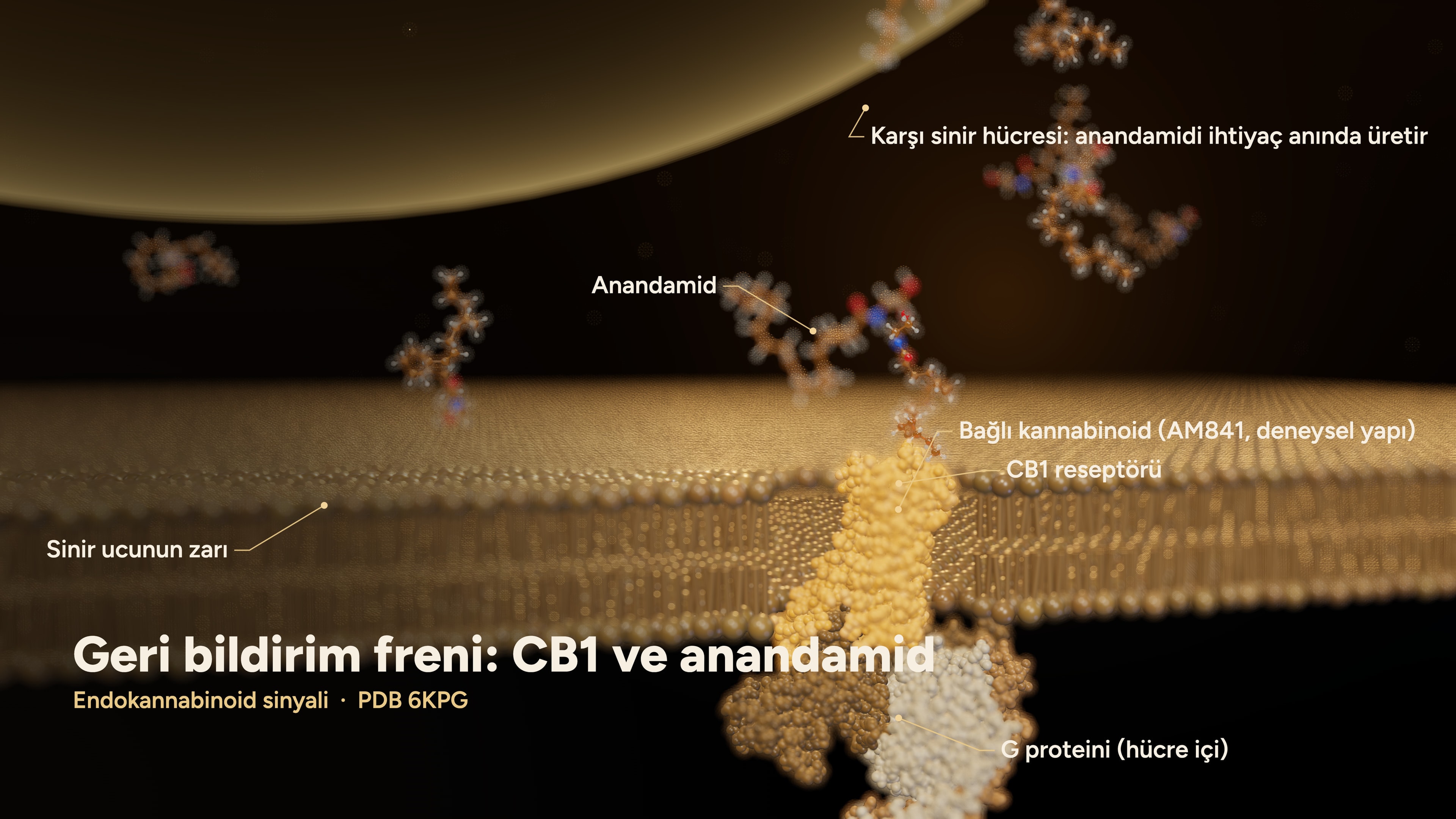
The phrase "cannabinoid signaling," which comes up often in articles about CBD and cannabis, can look technical at first glance. What it actually describes is a very elegant form of communication in our bodies. In this article we explain in plain language how this signal starts and ends, why it matters, how THC and CBD taken from outside the body affect it, and which parts of common claims are actually known. For a general introduction to the system, you can read our article on the endocannabinoid system.
What’s in this article?11 sections
What is cannabinoid signaling?
Our bodies have a regulatory network called the endocannabinoid system. This network has three parts: the cannabinoids the body makes (the best known are anandamide and 2-AG), the receptors they bind to (CB1 and CB2), and the enzymes that break down the molecules once their job is done (Lu and Mackie 2021). Cannabinoid signaling is the message these molecules pass to a cell by binding to a receptor. CB1 receptors are widespread in the brain; CB2 is found mainly on immune cells.
How does the signal start and end?
Nerve cells in the brain communicate with chemical messages across the tiny gaps between them (synapses). Cannabinoid signaling regulates this communication as follows:
- Stimulation: The nerve cell receiving messages is strongly stimulated.
- Release: This cell quickly releases anandamide and 2-AG (Wilson and Nicoll 2001).
- Traveling backward: The molecules cross the synaptic gap backward and bind to CB1 receptors on the cell that sent the message.
- Slowing down: The sending cell reduces the amount of message it releases, for a short or a long time (Kano 2009).
- Ending: Enzymes break down the cannabinoids and the signal ends.
Most messages in the brain flow from the sender to the receiver; that is why the discovery of backward signaling in 2001 opened a new era in research (Kano 2009). Today this backward transmission is accepted as the main route of cannabinoid signaling; in some cases it has been shown that it can also send signals in other directions (Castillo 2012).
What does this signal do?
The strengthening and weakening of synapses is one of the basic building blocks of learning and memory. Cannabinoid signaling is an important tool that regulates these changes at both excitatory and inhibitory synapses (Castillo 2012). The endocannabinoid system also takes part in brain development and in many cognitive and bodily processes (Lu and Mackie 2021). That is why we often compare the signal to a "volume knob": it does not cut the message off completely, it turns it down when needed.
To give an example: in the hippocampus, a region important for memory, CB1 receptors are found mostly at the endings of nerve cells that inhibit other cells (that is, tell them to "stop"). When a strongly stimulated cell releases cannabinoids, this inhibitory message decreases for a short time (Wilson and Nicoll 2001). In other words, depending on the situation, cannabinoid signaling can also loosen a brake; it is not a one-way "sedative."
How do cannabinoids taken from outside the body affect this signal?
- THC: THC, the substance behind marijuana's effects, binds directly to the CB1 receptor and activates it. While the body's own signal works where it is needed and for a short time, THC's effect spreads to many parts of the brain at once, because CB1 is widespread in the brain (Wilson and Nicoll 2001). In controlled studies, THC impaired attention and thinking speed (Woelfl 2020), and in some people it increased anxiety (Hutten 2022).
- Synthetic cannabinoids: Synthetic substances made to bind very strongly to CB1 are now seen as a serious public health problem (Di Marzo 2018).
- CBD: CBD does not activate CB1 the way THC does. In laboratory cell studies, it bound to a different site on the receptor and reduced the receptor's response to THC and 2-AG (Laprairie 2015). How much this effect matters in humans is not yet clear: in one study, CBD given beforehand did not reduce THC's negative effect on attention (Woelfl 2020).
Does disease follow when the signal is disrupted? What does the research say?
Laboratory and animal studies are exploring whether changes in cannabinoid signaling may be linked to many conditions, such as Alzheimer's, Parkinson's, skin diseases, heart disease and cancer. However, a comprehensive review in this field stresses that while the therapeutic potential of cannabinoids has broadened, the evidence is limited and the mechanisms are unclear (Lu and Anderson 2017). So with what we know today, it is not possible to say "if the signal is disrupted, this disease follows, and taking cannabinoids fixes it."
- Epilepsy: The area where CBD's effect has been shown in well-designed studies is certain drug-resistant epilepsy syndromes treated with an approved (licensed) CBD medicine (Devinsky 2017). Details are in our epilepsy article.
- Cancer: In the laboratory, cannabinoids have been shown to affect some tumor cells, but this has not been confirmed in humans. In an analysis of a study comparing CBD oil with placebo in people with advanced cancer, disease progression and survival over 56 days did not differ between the two groups (O'Leary 2024). Details are on the cancer claims page.
- Other conditions: A topic-by-topic summary of the evidence is in the CBD Guide.
Possible side effects and drug interactions
Cannabinoid signaling is a natural process in the body; cannabinoids taken from outside, however, are substances that act like drugs and can have side effects. THC can impair attention and increase anxiety. CBD, in 28 days of use in healthy adults, raised liver enzymes to more than 3 times the normal level in 5.6% of participants (Florian 2025), and it can slow the breakdown of some medicines in the body. Details are on the drug interactions page.
How was it used in studies?
Because this article is about a basic process in the body rather than a disease, we do not give dose information. The doses used in studies for each condition (study doses; not a personal recommendation) are on the relevant pages of the CBD Guide.
If you are thinking about using CBD
If you are considering CBD for a health problem, you can talk with your doctor or pharmacist about: where the evidence stands for your complaint, possible interactions with medicines you take, and any liver disease, pregnancy or breastfeeding.
In Turkey, products obtained from cannabis, including CBD, can be sold only in pharmacies (Law No. 7557, regulation of January 31, 2026). Those in the medicine and health product category are dispensed with a prescription; no prescription requirement is stated for support products with a THC content of no more than 0.3%. As of October 2026, there is no approved (licensed) CBD medicine in Turkey. Details are on the regulation page.
Conclusion
Cannabinoid signaling is an elegant feedback route through which nerve cells can tell each other to "slow down," and it plays a role in many processes such as learning and memory. Its place in disease is still being researched; for now, the areas where laboratory findings have turned into a treatment in humans are quite limited.
Frequently asked questions
What does cannabinoid signaling mean?
It is the message that cannabinoids the body makes itself, such as anandamide and 2-AG, pass to a cell by binding to CB1 and CB2 receptors. In the brain, this message mostly travels backward and reduces the output of the nerve cell that sent the message for a while.
Why does this signal matter?
By regulating the strengthening and weakening of synapses, it plays a role in processes such as learning and memory. The endocannabinoid system also takes part in brain development and in many bodily processes.
Does disrupted cannabinoid signaling cause cancer or Alzheimer's?
There is not enough information to say so. Links like these are mostly explored in laboratory and animal studies; comprehensive reviews stress that the evidence is limited. In people with advanced cancer, CBD oil did not affect disease progression or survival any differently from placebo.
How does CBD affect this signal?
CBD does not directly activate the CB1 receptor the way THC does. In cell studies it acted like a modulator that reduces the receptor's response to THC; how much this matters in humans is not yet clear.
Where can CBD products be bought in Turkey?
In Turkey, products obtained from cannabis, including CBD, can be sold only in pharmacies (Law No. 7557, regulation of January 31, 2026). Those in the medicine and health product category are dispensed with a prescription; no prescription requirement is stated for support products with a THC content of no more than 0.3%. As of October 2026, there is no approved (licensed) CBD medicine in Turkey.
References
Show 13 references
- Lu HC, Mackie K. Review of the Endocannabinoid System. Biol Psychiatry Cogn Neurosci Neuroimaging. 2021. PMID 32980261
- Wilson RI, Nicoll RA. Endogenous cannabinoids mediate retrograde signalling at hippocampal synapses. Nature. 2001. PMID 11279497
- Kano M, et al. Endocannabinoid-mediated control of synaptic transmission. Physiol Rev. 2009. PMID 19126760
- Castillo PE, et al. Endocannabinoid signaling and synaptic function. Neuron. 2012. PMID 23040807
- Woelfl T, et al. Effects of Cannabidiol and Delta-9-Tetrahydrocannabinol on Emotion, Cognition, and Attention: A Double-Blind, Placebo-Controlled, Randomized Experimental Trial in Healthy Volunteers. Front Psychiatry. 2020. PMID 33304282
- Hutten NRPW, et al. Cannabis containing equivalent concentrations of delta-9-tetrahydrocannabinol (THC) and cannabidiol (CBD) induces less state anxiety than THC-dominant cannabis. Psychopharmacology (Berl). 2022. PMID 36227352
- Di Marzo V. New approaches and challenges to targeting the endocannabinoid system. Nat Rev Drug Discov. 2018. PMID 30116049
- Laprairie RB, et al. Cannabidiol is a negative allosteric modulator of the cannabinoid CB1 receptor. Br J Pharmacol. 2015. PMID 26218440
- Lu Y, Anderson HD. Cannabinoid signaling in health and disease. Can J Physiol Pharmacol. 2017. PMID 28263083
- Devinsky O, et al. Trial of Cannabidiol for Drug-Resistant Seizures in the Dravet Syndrome. N Engl J Med. 2017. PMID 28538134
- O'Leary C, et al. Cannabidiol oil or placebo in advanced cancer-disease progression and survival: a secondary analysis. BMJ Support Palliat Care. 2024. PMID 38307703
- Florian J, et al. Cannabidiol and Liver Enzyme Level Elevations in Healthy Adults: A Randomized Clinical Trial. JAMA Intern Med. 2025. PMID 40622698
- Ministry of Health. Kenevirden Elde Edilen Ürünlere Dair Yönetmelik (Regulation on Products Derived from Hemp). Official Gazette, January 31, 2026, issue 33154. Official Gazette 33154
 Hemp and Marijuana: What’s the Difference?
 CBD and the Immune System
 What Is Marijuana?
 Your Body's Hidden Balancing System: The Endocannabinoid System (ECS) and CBD's Role