
What is THC-COOH and how long does it stay in your system? CBD and drug tests
Last updated: SourcedWe don’t sell products.
What's on this page?
What is THC-COOH, and what do tests look for?
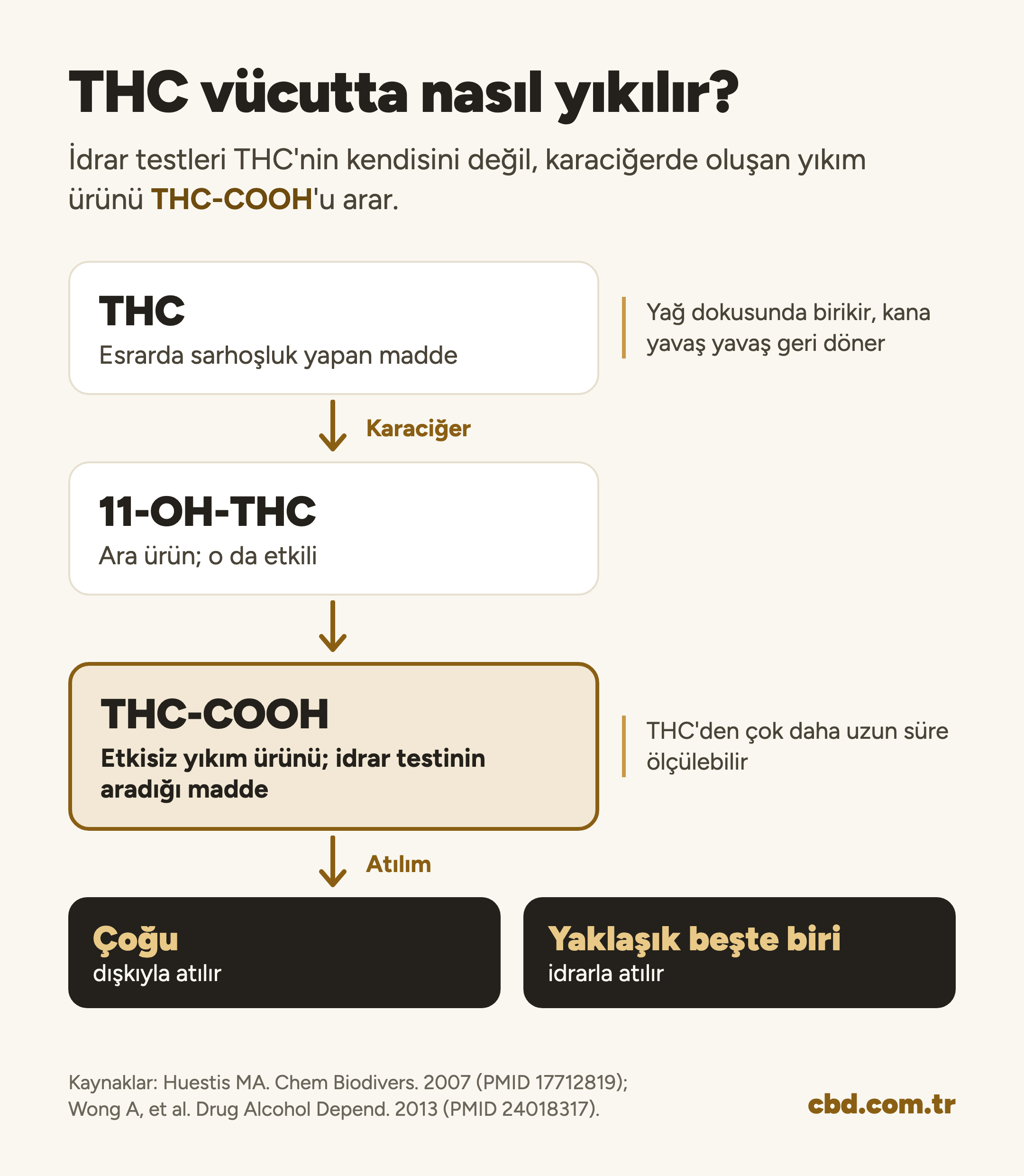
THC-COOH (full name 11-nor-9-carboxy-THC) forms when the liver breaks down THC, the substance in marijuana that causes a high. It doesn’t cause a high itself, but because it leaves the body much more slowly than THC, urine tests look for it. So THC-COOH isn’t a separate drug: finding it on a test shows that the person was exposed to THC. That THC can come from marijuana or from a CBD product that contains THC; a standard test can’t tell the two apart. First a quick screening test is done; if it’s positive, a more precise confirmation test is done in a lab. In US workplace testing, the screening cutoff is 50 ng/mL and the confirmation cutoff is 15 ng/mL. In a controlled study, pure CBD did not turn into THC in the body, however it was taken.
How many days does it show up in a urine test?
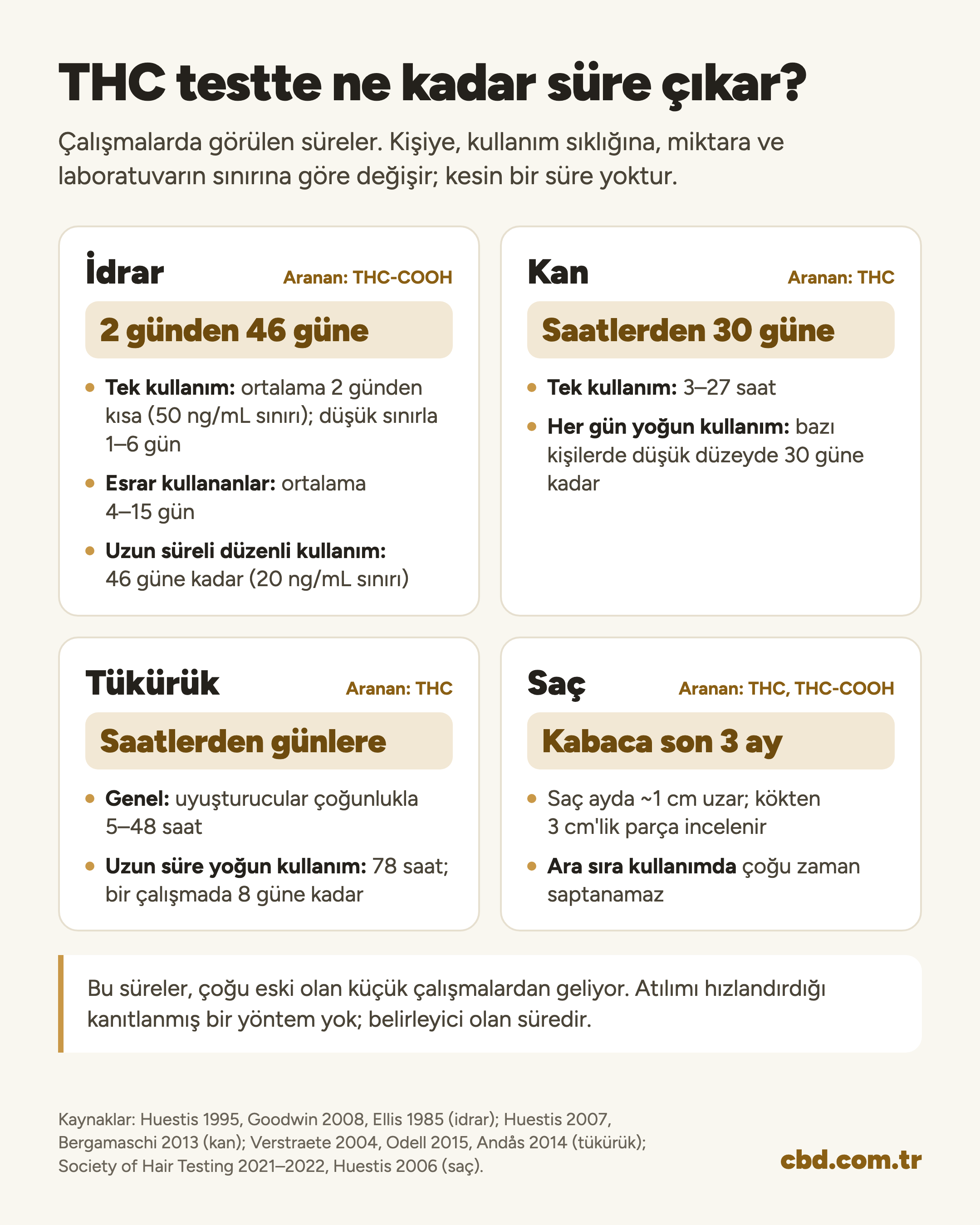
It isn’t possible to give an exact number of days; the time depends mostly on how often a person uses, how much they use, the lab’s cutoff and the individual. In 6 volunteers who smoked a single marijuana cigarette, urine tests stayed positive for less than 2 days on average at the 50 ng/mL screening cutoff common in workplaces; with a lower cutoff (20 ng/mL), this averaged between 1 and 6 days. In a study that followed 60 marijuana users under supervision, the last positive urine sample, judged against each person’s starting level, came 4 to 15 days later on average. In 86 long-term regular users, results were positive for up to 46 days with a low cutoff (27 days on average); some had a positive result again after a negative one. This information comes from small studies, most of them old; differences from person to person are large.
How long does it stay in blood, saliva and hair?
THC falls quickly in the blood. In volunteers who smoked a single marijuana cigarette, THC could be measured in the blood for 3 to 27 hours, depending on the amount taken, and its breakdown product THC-COOH for about 2 to 7 days. The picture is different in heavy daily users: in some of 30 people followed under supervision after they stopped, low levels of THC could be measured in the blood for 30 days. Saliva tests usually detect drugs for 5 to 48 hours, but in long-term heavy users this can be longer: THC was found for up to 78 hours in one study and up to 8 days in another. Hair testing looks back the furthest: because hair grows about 1 cm a month, a 3 cm segment cut at the root roughly reflects the last three months. But in occasional users, the amount in hair is often too small to measure: in one study, cannabinoids were found in the hair of 85% of daily users but only 52% of those who used 1–5 times a week.
How does the body clear THC-COOH?
THC builds up in fat tissue and slowly returns to the blood from there, so in regular users it takes a long time to leave the body completely. Most of the THC taken leaves the body as breakdown products in stool, and about one fifth in urine; the main substance in urine is THC-COOH. We know of no method shown in controlled studies to speed this up; what matters is the time since last use. In a small study of 14 regular users, 35 minutes of cycling didn’t lower THC in the blood; instead, it raised it slightly. The researchers attribute this to THC released from fat tissue into the blood. If you want to stop using marijuana, or you’re worried about someone close to you, in Turkey the Yeşilay Counseling Center (YEDAM) helpline at 115 offers free support to people with addiction and their loved ones.
What did studies with pure CBD show?
Volunteers were given a single dose of 100 mg of pure CBD (swallowed or vaporized). Only 1 of 218 urine samples was positive at the most sensitive screening cutoff; none exceeded the confirmation cutoff. Among 10 people who took 100 mg of pure CBD twice a day for two weeks, 1 had a positive urine sample, and the paper didn’t explain why. So a positive result isn’t expected with pure CBD, but the chance isn’t exactly zero.
Is even a small amount of THC enough?
Yes, it can be. In one study, 0.5 to 3.7 mg of THC was added to an oil containing 100 mg of CBD, and it was taken twice a day for two weeks. In every group that received THC, at least one person tested positive; in the highest-THC group, 10 out of 10 people were positive. These people didn’t feel more affected than those taking pure CBD, and attention tests showed no difference. In Turkey, supplement products that may be sold in pharmacies can contain at most 0.3% THC; a product below this limit still doesn’t guarantee a negative test.
Can I trust the label?
About one fifth of 84 CBD products bought online contained THC. In almost half of 186 CBD oils collected in Europe over ten years, the amount of CBD didn’t match the label; some contained THC and similar substances. In one study, a cannabis compound that wasn’t listed on the product’s lab analysis certificate showed up in users’ urine.
Saliva tests and products applied to the skin
Two common roadside saliva test devices gave no positive results in volunteers who swallowed between 15 and 1500 mg of pure CBD. With CBD oils containing small amounts of THC, however, saliva tests could also come back positive. Five CBD products applied to the skin didn’t make urine tests positive; but, unexpectedly, THC above the workplace cutoff was measured in the saliva of 9 people.
Frequently asked questions
What is THC-COOH, and which drug is it a trace of?
THC-COOH is the breakdown product formed when the body breaks down THC, the substance in marijuana that causes a high; it doesn’t cause a high itself. Finding it on a test shows exposure to THC: that THC can come from marijuana or from a CBD product that contains THC.
How many days until a urine test comes back clean?
It depends on how often a person uses, and there’s no exact timeline. In studies, after a single use, tests stayed positive for less than 2 days on average at a common test cutoff; in people who used marijuana, positive results were seen for 4–15 days on average; and in long-term regular users, with a lower cutoff, results were positive for up to 46 days.
How many days do cannabinoids stay in the blood?
In occasional users, THC falls in the blood within hours, and its breakdown product can be measured for a few days. In heavy daily users, though, low levels of THC could be measured for up to 30 days after stopping.
How does the body clear THC-COOH, and can you speed it up?
It is broken down in the liver, and most of it leaves the body in stool, some in urine. No method has been proven to speed this up; what matters is time. In a small study, exercise didn’t lower THC in the blood; instead, it raised it slightly.
Does pure CBD turn into THC in the body?
No. In a controlled study, pure CBD did not turn into THC, whether it was swallowed or vaporized. The main cause of positive results is the THC in the product.
Can a test tell CBD product use apart from marijuana use?
No. Standard tests can’t tell where the THC came from. A CBD product that contains THC can give a positive result just like marijuana.
Is a product labeled 'THC-free' safe?
Not for certain. A large share of labels don’t match what’s actually in the product. An independent lab certificate gives you an idea, but it may not show everything.
After I stop CBD, when will a test come back clean?
There’s no exact timeline. Among people who used CBD oil with a little THC for two weeks, very few still tested positive after a one-week break. With more THC or longer use, it can take longer.
Does a CBD cream applied to the skin affect a test?
In one study, products applied to the skin did not make urine tests positive. However, THC was measured in some people’s saliva, so the risk can’t be ruled out entirely where saliva tests are used.
Sources
Show 23 references
- Spindle 2020, PMID 31682266
- Sholler 2022, PMID 34089060
- Wolinsky 2026, PMID 40704705
- Bonn-Miller 2017, PMID 29114823
- Binova 2026, PMID 42611266
- Gillham 2026, PMID 40920736
- McCartney 2022, PMID 34412166
- Vikingsson 2026, PMID 41252452
- Zamarripa 2024, PMID 38217086
- Huestis 2007, PMID 17712819
- Huestis 1995, PMID 8926739
- Goodwin 2008, PMID 19007504
- Ellis 1985, PMID 3902318
- Bergamaschi 2013, PMID 23449702
- Verstraete 2004, PMID 15228165
- Odell 2015, PMID 25698515
- Andås 2014, PMID 24819969
- Huestis 2006, PMID 16963215
- SoHT 2022 (general consensus on hair testing), www.soht.org
- SoHT 2021 (consensus on drug testing in hair), www.soht.org
- Wong 2013, PMID 24018317
- Kenevirden Elde Edilen Ürünlere Dair Yönetmelik (Regulation on Products Derived from Hemp) (Official Gazette 33154, 31.01.2026), www.resmigazete.gov.tr
- YEDAM 2026 (115 Helpline), www.yedam.org.tr
All safety topics · Check a drug interaction · Myth or fact?